José Antonio Zamudio, first Spaniard to receive a Google PhD Fellowship in Software Engineering

José Antonio Zamudio, first Spaniard to receive a Google PhD Fellowship in Software Engineering

Uncategorized
José Antonio Zamudio, first Spaniard to receive a Google PhD Fellowship in Software EngineeringJosé Antonio Zamudio Amaya, PhD researcher at the University of Seville and the CISPA Helmholtz Center for Information Security, has been awarded a Google PhD Fellowship 2026 in the Software Engineering and Programming Languages category. He is the first Spanish researcher to receive this recognition in the area since the programme was launched in 2009.A highly selective programmeThe Google PhD Fellowship is one of the most competitive international programmes for doctoral students. Candidates cannot apply directly. Each university may nominate up to three students, and Google assesses the research proposal, its expected impact, the academic record and the leadership potential of each nominee. The 2026 edition selected 148 PhD students from 38 countries.The fellowship includes:Two years of…
Read More
Jens Mönig Takes Us Inside Snap! at the ETSII

Jens Mönig Takes Us Inside Snap! at the ETSII

Uncategorized
On 17 November 2026, the Escuela Técnica Superior de Ingeniería Informática of the University of Seville hosted the seminar “Snap! from the inside: how one of the world’s most popular visual languages is designed and built”, delivered by Jens Mönig (SAP). The talk was part of the seminar series “La informática en la encrucijada” (Computing at the Crossroads) and took place in the Sala Multiusos.Jens Mönig is a researcher at SAP and a creator of interactive programming environments. During the session, he went through his career in visual programming, from his work on languages such as Scratch and GP to his role as lead architect and developer of Snap! Build Your Own Blocks. Snap! is used by hundreds of thousands of people and is the foundation of the Beauty and…
Read More
Únete a Diverso Lab como alumna/o interna/o en el curso 2026-2027

Únete a Diverso Lab como alumna/o interna/o en el curso 2026-2027

Announcement, Product lines, Uncategorized
Diverso Lab abre sus puertas al estudiantado de la Escuela Técnica Superior de Ingeniería Informática (ETSII) de la Universidad de Sevilla que desee incorporarse al grupo como alumnas y alumnos internos durante el curso 2026-2027.Esta convocatoria, gestionada por el Departamento de Lenguajes y Sistemas Informáticos (LSI), ofrece la oportunidad de iniciarse en la investigación desde las primeras etapas de la carrera de la mano de Don Francisco José Domínguez Mayo y Don David Benavides Cuevas. Las personas seleccionadas trabajarán junto a los investigadores del grupo en áreas como la variabilidad del software, el modelado de características, el Universal Variability Language (UVL) y la gobernanza inteligente, y adquirirán experiencia práctica con herramientas desarrolladas en el laboratorio, como flamapy y UVLHub.Cómo solicitarloLas personas interesadas deben enviar el formulario de solicitud, junto con su…
Read More
Glass Parrot is now available

Glass Parrot is now available

Uncategorized
Glass Parrot, a tool developed by Elena Tomás Vela as part of her Master’s thesis (TFM), supervised by Francisco José Domínguez Mayo and Jesús Moreno León, is now deployed on Diverso Lab’s servers and freely accessible at: https://glass-parrot.diversolab.net/Glass Parrot is designed to help learners of all ages understand how the large language models behind today’s most popular AI assistants work. It is a simple, transparent language model, a “glass parrot”, that users train with their own texts. As it generates text, it displays the candidate next words and their probabilities, making visible a mechanism that large models keep hidden. Working with it, learners explore in a tangible way concepts such as bias, the stochastic nature of these models and the central role of training data.The tool was presented at the…
Read More
David Benavides habla sobre IA, datos y el doctorado en Conectadas Andalucía

David Benavides habla sobre IA, datos y el doctorado en Conectadas Andalucía

Uncategorized
El profesor David Benavides, miembro de DiversoLab y coordinador del Programa de Doctorado en Informática de la Universidad de Sevilla, participó como invitado en el podcast Conectadas Andalucía. En la conversación abordó el papel de la inteligencia artificial en la formación doctoral en informática.Del grado a la investigaciónBenavides comenzó repasando su trayectoria antes de asumir la coordinación del programa de doctorado. Después explicó las diferencias entre el grado, el máster y el doctorado. Destacó que el doctorado es la etapa que proporciona las habilidades necesarias para investigar.Una generación de pioneros en tiempos de incertidumbreSobre las líneas de investigación actuales, Benavides señaló que los doctorandos de hoy son, en cierto modo, conejillos de indias: nadie sabe todavía hacia dónde llevará la inteligencia artificial a la disciplina. A esa incertidumbre se suman…
Read More
David Benavides delivers a keynote at ICI2ST 2026 in Quito on the relationship between AI and Software Engineering

David Benavides delivers a keynote at ICI2ST 2026 in Quito on the relationship between AI and Software Engineering

Doctors, Events, Product lines, Seminar, Uncategorized
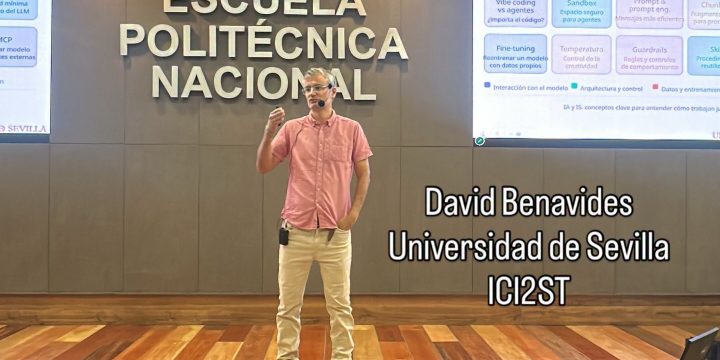
Prof. David Benavides, director of Diverso Lab, travelled to Quito, Ecuador, to deliver a keynote at the Sixth International Conference on Information Systems and Software Technologies (ICI2ST 2026), held from 23 to 25 September 2026 at the Hemiciclo Politécnico. The conference was organized by the Faculty of Systems Engineering of the Escuela Politécnica Nacional (EPN), together with a consortium of Ecuadorian and Colombian universities.His keynote, "Artificial Intelligence and Software Engineering: Friends or Enemies?", addressed one of the most pressing questions in the discipline today. Artificial intelligence is rapidly changing the way software is conceived, built and maintained, raising both opportunities and concerns across the community. The talk explored whether these two fields are competing or complementary, and what role software engineering must play in ensuring that AI-based systems are reliable,…
Read More
Salvador Muñoz Publishes on Smart Governance in Digital Government: Research and Practice

Salvador Muñoz Publishes on Smart Governance in Digital Government: Research and Practice

Announcement, Doctors, Paper news, Product lines, Projects, Uncategorized
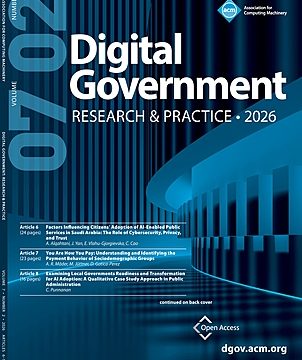
Salvador Muñoz Hermoso has had his paper "Exploring Smart Governance Challenges in Local Governments: Insights from a Delphi Study in Spain" accepted for publication in Digital Government: Research and Practice, the ACM journal devoted to digital government and public sector transformation. The manuscript was accepted as a Research Paper in its current form. The work is co-authored with Miguel A. Olivero, Francisco J. Domínguez-Mayo, and David Benavides.The paper is a result of the doctoral research that Salvador carried out at the University of Seville, where his industrial doctorate focused on e-collaboration and smart governance. He defended his thesis in September 2025. Throughout that research he combined academic work with more than two decades of professional experience in the development and management of electronic administration and local government projects, a background…
Read More
Six Diverso Lab Contributions Accepted at VARIABILITY 2026

Six Diverso Lab Contributions Accepted at VARIABILITY 2026

Uncategorized
Diverso Lab is proud to share that six of our contributions have been accepted for VARIABILITY 2026, the International Conference on Software and Systems Reuse, Product Lines, and Configuration. This first edition of the conference brings together three long-standing venues in the field, SPLC, VaMoS and ICSR, and will take place in Limassol, Cyprus, from 29 September to 2 October 2026.Our accepted work spans the main track, the journal-first track and the MODEVAR workshop, and reflects the breadth of our research on variability modelling, automated analysis and the Universal Variability Language (UVL).Main TrackAutomated Analysis of UVL using Satisfiability Modulo Theories, by José Miguel Horcas, Francisco S. Benítez, José A. Galindo and David Benavides. This paper presents our advances in using the Z3 solver for the automated analysis of feature models,…
Read More
David Romero Organvídez Defends His Doctoral Thesis on the UVL Ecosystem

David Romero Organvídez Defends His Doctoral Thesis on the UVL Ecosystem

Doctors, Events, Product lines, Uncategorized
On 14 July 2026, David Romero Organvídez successfully defended his doctoral thesis at the University of Seville, earning his PhD with International Doctorate Mention with the maximum grade. The thesis, titled "UVLHub: An Open Science Ecosystem for the Universal Variability Language", was supervised by Dr. David Benavides and Dr. José A. Galindo, both members of Diverso Lab.The work addresses a long-standing problem in software product line engineering: feature models, the de facto standard for representing variability and commonalities in software systems, have often been scattered across private repositories, incompatible formats, or discontinued projects. This dispersion has made it difficult for researchers and practitioners to find, reuse, and study these artefacts.At the core of the thesis is UVLHub, a repository of feature models built on the Universal Variability Language (UVL), a…
Read More
David Benavides on How AI Is Reshaping Software Development in 2026

David Benavides on How AI Is Reshaping Software Development in 2026

Uncategorized
David Benavides, professor and coordinator of the PhD program in Computer Engineering at the University of Seville, shares his perspective on the state of software development in 2026 in a feature published by Computerworld España.Benavides describes artificial intelligence as the biggest umbrella driving change across the sector, highlighting the shift from AI copilots that simply complete code to agentive AI systems capable of receiving instructions and orchestrating entire workflows. He also points to "vibe coding" as a parallel trend, one that lets non-engineers produce software through conversational interaction with AI systems, distinguishing it from the more technical, AI-assisted engineering carried out by professional developers.On the technical side, Benavides discusses the growing adoption of WebAssembly, which allows software components to run directly in the browser and distributes computing costs to the…
Read More