
UVL Paper Surpasses 100 Citations and Launches the new UVL Ecosystem Portal

UVL Paper Surpasses 100 Citations and Launches the new UVL Ecosystem Portal

Announcement, Paper news, Product lines, Projects
The article “UVL: Feature modelling with the Universal Variability Language”, published in The Journal of Systems and Software (Volume 225, 2025), has surpassed 100 citations. The work, which also received the JSS Best Paper Award 2025 (Regular Track), is authored by David Benavides and José A. Galindo (Universidad de Sevilla), together with Chico Sundermann, Kevin Feichtinger (Karlsruhe Institute of Technology), Rick Rabiser (Johannes Kepler University Linz) and Thomas Thüm.To mark this milestone, we are pleased to highlight the new UVL Ecosystem portal (https://uvl-ecosystem.org/), a single entry point to the language, its tools, its community and its history.A common language for variability modelsFeature modelling has been a central technique in software product line engineering since 1990, but researchers and practitioners have long relied on their own notations, making it difficult to…
Read More
Feature-Focused Test Generation presented at ASE 2026 in Munich

Feature-Focused Test Generation presented at ASE 2026 in Munich

Events, Paper news, Product lines, Projects
José Antonio Zamudio Amaya presented the paper “Feature-Focused Test Generation” at the 41st IEEE/ACM International Conference on Automated Software Engineering (ASE 2026), held in Munich, Germany, from 12 to 16 October 2026. The work was presented in the main track on Wednesday 14 October in Forum 7. A poster session ran throughout the same day.The paper is co-authored by José Antonio Zamudio Amaya, Gaetano Sapia, Alexi Turcotte, Marcel Böhme and Andreas Zeller (CISPA Helmholtz Center for Information Security and MPI-SP), and David Benavides (Instituto de Ingeniería Informática, Universidad de Sevilla). It is the first joint publication between Diverso Lab and CISPA, and brings together two research communities: language-based testing and software product line engineering.What the work proposesSpecification-based test generators produce valid inputs that cover the whole input space of a…
Read More
AI as a Tutor, Not an Answer Machine: Maidelis Milanés Presents Her Research on Computational Thinking

AI as a Tutor, Not an Answer Machine: Maidelis Milanés Presents Her Research on Computational Thinking

Doctors, Events, Projects
Generative AI and Computational Thinking to Improve Programming Learning: Maidelis Milanés Presents Her ResearchToday, Maidelis Milanés Luque, lecturer at the University of Informatics Sciences (UCI, Cuba), presented her research at Diverso Lab on the use of generative artificial intelligence to support programming learning in higher education.In Cuba, as in many other parts of the world, the first-year introductory programming course is a significant challenge for students, with high failure and dropout rates. To help improve this situation, her research proposes the use of generative AI tools in an ethical and critical way, grounded in the pillars of computational thinking.To assess the effectiveness of this approach, a study was carried out with around 200 first-year students, divided into a control group and an experimental group. The results are very promising, showing…
Read More
José A. Galindo Receives a Most Influential Paper Award at VARIABILITY 2026

José A. Galindo Receives a Most Influential Paper Award at VARIABILITY 2026

Announcement, Doctors, Paper news, Product lines, Projects
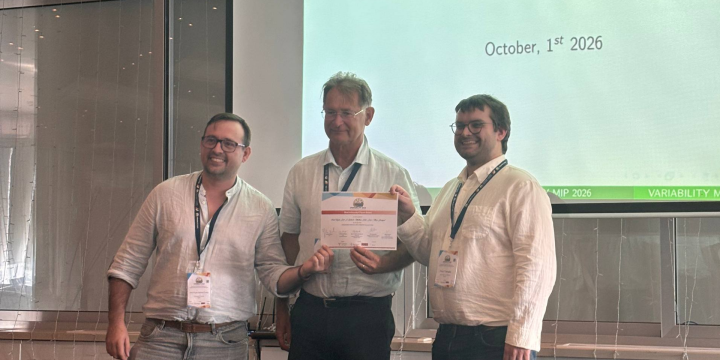
José A. Galindo, researcher at Diverso Lab and the Department of Computer Languages and Systems of the University of Seville, has received a Most Influential Paper (MIP) award at VARIABILITY 2026, held in Limassol, Cyprus, from 29 September to 2 October. The award recognises "Using Machine Learning to Infer Constraints for Product Lines" (Paul Temple, José A. Galindo, Mathieu Acher and Jean-Marc Jézéquel), presented at SPLC 2016 in Beijing. https://dl.acm.org/doi/abs/10.1145/2934466.2934472What sets an MIP apart is its timing. It is not awarded when a paper is published, but ten years later, when a committee can look back and judge which contributions actually shaped the field.The paper addressed a long-standing problem in variability-intensive systems: finding a set of constraints that is both precise, allowing every correct configuration, and complete, never allowing a…
Read More
Esther Rocío Valladolid presents UVL-based variability modelling of drone propellers at MODEVAR 2026

Esther Rocío Valladolid presents UVL-based variability modelling of drone propellers at MODEVAR 2026

Events, Master's thesis, Paper news, Product lines, Projects, Seminar
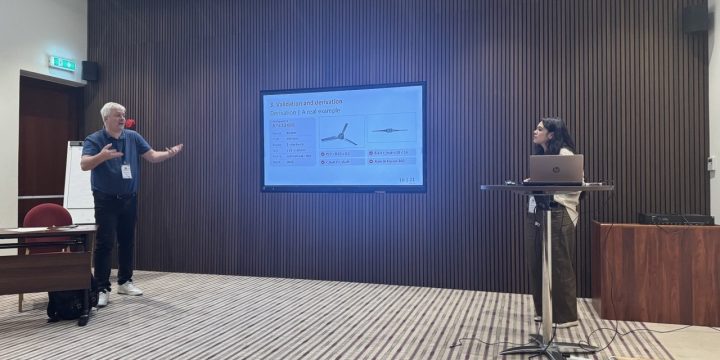
On 29 September 2026, Esther Rocío Valladolid Ortíz presented "Towards UVL-based variability modelling of drone propellers" at MODEVAR 2026, the International Workshop on Languages for Modelling Variability, held as part of VARIABILITY 2026 in Limassol, Cyprus. The work is co-authored with David Romero-Organvidez, José Antonio Pérez Castellanos and David Benavides, from the University of Seville.Feature models are usually applied to software, where a feature is a choice that is either included in a configuration or not. Physical engineering domains are just as variable, but their variability is often continuous and bound by physics. The design of a drone propeller depends on numeric parameters such as radius and pitch, together with discrete choices such as the number of blades or the tip shape, and these parameters are linked by physical relations…
Read More
UVL-driven configuration of YOLOv11 at MODEVAR 2026

UVL-driven configuration of YOLOv11 at MODEVAR 2026

Events, Paper news, Product lines, Projects, Seminar
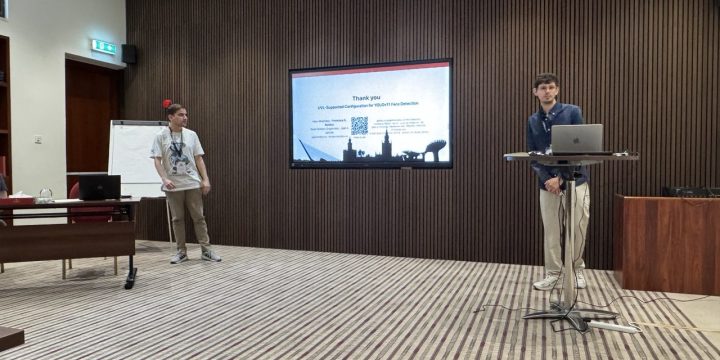
On 29 September 2026, the work "UVL-Supported Configuration for YOLOv11 Face Detection" was presented at MODEVAR 2026, the International Workshop on Languages for Modelling Variability, held as part of VARIABILITY 2026 in Limassol, Cyprus. The research was led by Haya Alhadramy (Al al-Bayt University, Jordan), in collaboration with Francisco S. Benítez, David Romero-Organvidez and José A. Galindo from the University of Seville.The work addresses a common problem in deep learning practice: choosing a model configuration. Training a face detector involves dozens of interdependent decisions, from backbone scale and attention blocks to input resolution, augmentation, precision and post-processing. These choices are usually made by hand, often copied from previous projects, with nothing to check that the resulting combination is coherent.The authors apply software product line engineering to this problem. They model…
Read More
Salvador Muñoz Publishes on Smart Governance in Digital Government: Research and Practice

Salvador Muñoz Publishes on Smart Governance in Digital Government: Research and Practice

Announcement, Doctors, Paper news, Product lines, Projects, Uncategorized
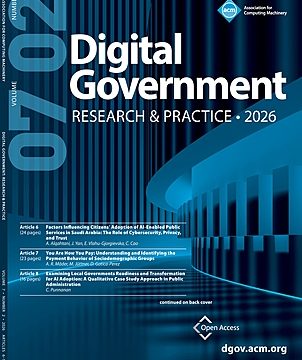
Salvador Muñoz Hermoso has had his paper "Exploring Smart Governance Challenges in Local Governments: Insights from a Delphi Study in Spain" accepted for publication in Digital Government: Research and Practice, the ACM journal devoted to digital government and public sector transformation. The manuscript was accepted as a Research Paper in its current form. The work is co-authored with Miguel A. Olivero, Francisco J. Domínguez-Mayo, and David Benavides.The paper is a result of the doctoral research that Salvador carried out at the University of Seville, where his industrial doctorate focused on e-collaboration and smart governance. He defended his thesis in September 2025. Throughout that research he combined academic work with more than two decades of professional experience in the development and management of electronic administration and local government projects, a background…
Read More
From Data to Irrigation: SensOlive’s Tools for Optimizing Deficit Irrigation

From Data to Irrigation: SensOlive’s Tools for Optimizing Deficit Irrigation

Announcement, Product lines, Projects
The foundation of irrigation scheduling in SensOlive (PLSQ_00162).Project funded by the Junta de Andalucía. What we measure and how: the tools and indicators we use for our objectivesIn our first installment, we took you on a visit to La Hampa. Today we get a little closer to show you the tools we work with and the factors we take into account to understand, day by day, what the olive grove needs. Optimizing deficit irrigation isn't just about watering less: it's about watering with a purpose, and to do that we need to know precisely how each tree responds. In this video we show you the continuous measurement indicators we rely on, along with other measures we use to verify them. Along the way you'll see:How trunk diameter variation is measured…
Read More
José Manuel Sánchez Presents SensOlive at SISTEDES 2026

José Manuel Sánchez Presents SensOlive at SISTEDES 2026

Announcement, Events, Product lines, Projects, Seminar, Uncategorized
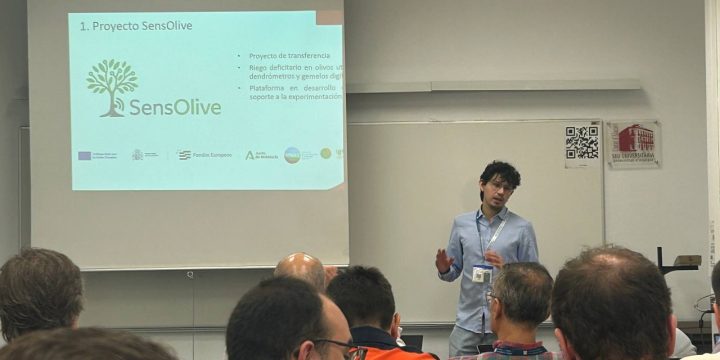
SensOlive brings software variability and digital twins to one of today’s most urgent agricultural challenges: efficient irrigation in olive groves. During SISTEDES 2026, held in Alicante from 16 to 18 June, our colleague José Manuel Sánchez Ruiz presented the work titled “Proyecto - SENSOLIVE: Variability Management and Digital Twins in Deficit Irrigation of Olive Groves”. The conference brought together the Spanish software engineering community and included JISBD, JCIS and PROLE as its main scientific tracks. The article was authored by José Manuel Sánchez Ruiz, Francisco Sebastián Benítez Ruiz Díaz, Noelia López Durán, Miguel Ángel Olivero González, Francisco José Domínguez Mayo, Marta Sánchez Piñero and David Benavides Cuevas. Managing variability in precision irrigation The SensOlive project addresses a key problem in modern agriculture: how to support deficit irrigation strategies in olive…
Read More
Francisco Sebastián Benítez Presents a Tool for Variability Management in Irrigation and Agriculture

Francisco Sebastián Benítez Presents a Tool for Variability Management in Irrigation and Agriculture

Events, Product lines, Projects, Seminar, Uncategorized
DiversoLab continues exploring how software variability can support smarter and more adaptable agricultural systems.At SISTEDES 2026, our colleague Francisco Sebastián Benítez presented the work titled “Herramienta - A Tool for Variability Management in Irrigation and Agriculture”. The conference took place in Alicante from 16 to 18 June 2026 and gathered researchers and professionals from the Spanish software engineering and software development technologies community.The article was authored by Francisco Sebastián Benítez, José Manuel Sánchez Ruiz, David Romero Organvídez, Miguel Ángel Olivero, José A. Galindo, Francisco José Domínguez-Mayo and David Benavides.A tool-oriented contribution for smart agricultureThe presented work focuses on the development of a tool for managing variability in irrigation and agricultural contexts. This is a relevant challenge because agricultural systems are highly configurable: crops, sensors, irrigation strategies, environmental conditions and user…
Read More