How do LLMs really work? We have an answer

How do LLMs really work? We have an answer

Events, Seminar, Uncategorized
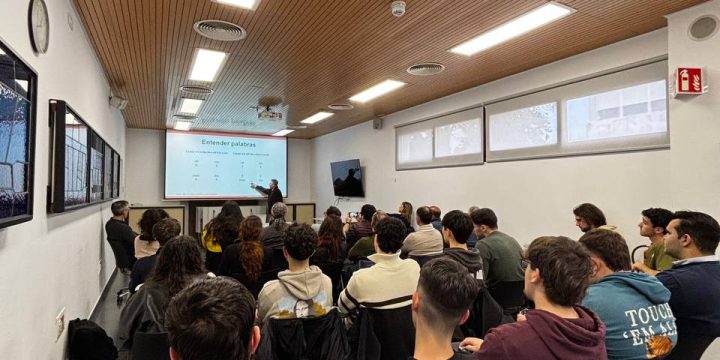
The seminar “¿Cómo funcionan los LLMs? Una explicación simple y accesible” delivered by Jesús Moreno León at the School of Computer Engineering of the University of Seville, concluded with outstanding attendance and a very positive reception from participants.Organized as part of the seminar series “Computer Science at the Crossroads,” the session brought together students, educators, and researchers interested in gaining a clear understanding of how large language models operate and the growing impact of artificial intelligence. The talk covered key concepts such as transformer architectures, machine learning foundations, and the role of AI assistants in educational and professional contexts. Thanks to its accessible and outreach-oriented approach, the seminar enabled attendees with diverse backgrounds to follow the explanations easily and actively engage in the discussion session that followed, fostering meaningful reflection…
Read More
How do LLMs really work?

How do LLMs really work?

Events, Seminar, Uncategorized
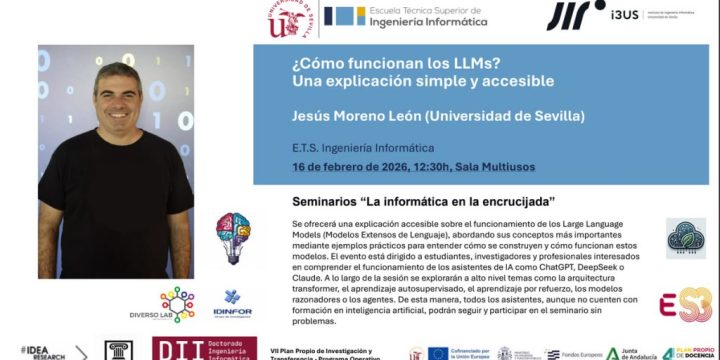
On February 16th, 2026, at 12:30 PM, the seminar entitled “¿Cómo funcionan los LLMs Una explicación simple y accesible” will take place in the Multi-Purpose Room at the School of Computer Engineering (University of Seville). The session will be delivered by our colleague Professor Jesús Moreno León.The seminar will provide a clear and accessible explanation of how Large Language Models (LLMs) work, covering their fundamental concepts through practical examples that help the audience understand how these models are built and how they are applied in current technological solutions.The event is aimed at students, researchers, and professionals interested in understanding how AI assistants such as ChatGPT, DeepSeek, or Claude operate. High-level topics such as transformer architecture, self-supervised learning, and reinforcement learning will be discussed from a divulgative perspective, avoiding unnecessary technicalities or…
Read More

CSIC AIHUB Summer School 2024

Events, Seminar
The 3rd CSIC AIHUB Summer School took place during the first week of July in Valencia, Spain, and DiversoLab US group had an important presence in the event. Our coworker and professor, Jesús Moreno León, took part in 3 of the sessions, including: A seminar on generative AI educational resources (Picture 1) A workshop on the development of a music generator and the use of AI techniques in state-of-the-art film creations (Picture 2) An expert panel on the development and assessment of AI initiatives in K-12 education Picture 1 Picture 2 Designed for teachers and researchers interested in artificial intelligence, this training opportunity provided a comprehensive and specialized program in one of the main areas of research in recent years. For one week, participants had the opportunity to immerse themselves…
Read More

DiversoLab Seminars: Innovation in IT

Events, Seminar
We're back with the seminars, and this week we bring you a seminar led by our colleague and professor Francisco José Dominguez. As always, we'll be gathering this Thursday, the 16th 10:30, in room A2.11 open to everyone and will last 30-45 minutes as usual. Below, we provide an introduction to this week's seminar: When facing a software project, one of the most relevant challenges is the uncertainty that the vast majority of these projects entail, especially concerning business (what should we build) and technology (how should we build it). The challenge escalates when dealing with an R&D project where the goal is to obtain IT innovation that allows gaining a competitive advantage. Software projects (or operations) can be of different natures, but we don't always consider what the most…
Read More

A New Seminar on “UVLHub and Open Science”

Events, Seminar
This week, on Thursday 21st, we start off with the second seminar of the calendar, which is called "UVLHub and Open Science" and led by our colleague and professor David Romero. Open Science is a current trend that allows open access to scientific results, but how does that translate into practice? In the field of software product lines, feature models are crucial for managing variabilities and similarities in product development, facilitating tasks such as product configuration and testing. Despite their importance, access to these models is restricted, as many are in private repositories or discontinued projects. To overcome these limitations, David Romero's doctoral thesis introduces the Universal Variability Language (UVL), which aims to standardize how these models are serialized, regardless of the tools used. However, current solutions for sharing models…
Read More

Last week’s Seminar on “Challenges in Computational Thinking”

Events, Seminar
Last Thursday, we inaugurated the seminar calendar with a presentation by Jesús Moreno on "Challenges in Computational Thinking". The seminar addressed the key findings of recent research on the role of computational thinking in education. Specifically, the issue was explored through three main axes: the assessment of computational thinking skills, their transfer to other domains, and the factors influencing their development. The presentation highlighted the design and validation of various educational tools and software, such as the Dr. Scratch tool (http://www.drscratch.org), which has become almost a standard in educational and academic communities globally. Subsequently, the main actions taken in the last decade at the Ministry of Education were reviewed, leading to the inclusion of computational thinking skills in the curriculum of all non-university educational stages. Results from an emerging research…
Read More