SensOlive In Action: A Behind-the-Scenes Look at the La Hampa Farm

SensOlive In Action: A Behind-the-Scenes Look at the La Hampa Farm

Uncategorized
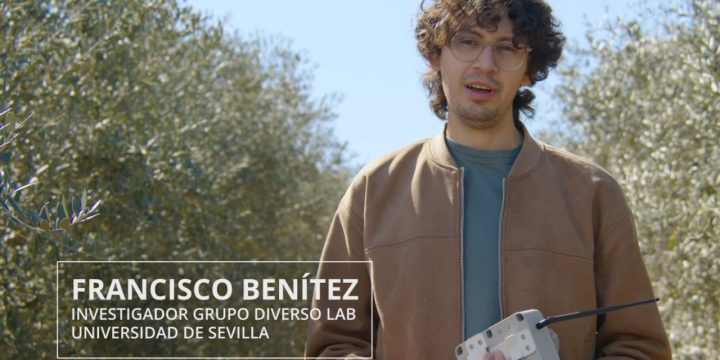
As you already know, the SensOlive project is focused on optimizing deficit irrigation systems in olive groves through the use of dendrometers and smart digital twins. We’ve shared the goals and the theory behind our work, but today, we want to show you exactly how we make it happen on the ground.We recently took the cameras to La Hampa, the IRNAS-CSIC experimental farm, to give you an exclusive, up-close look at the technology and the daily work driving this project forward.In the video below, we walk you through our setup and show you:The Testing Grounds: You will get to see the La Hampa facilities, featuring 7-year-old Manzanilla olive trees planted in hedgerows.Ongoing Trials: We discuss the fieldwork we have been conducting since 2021 to fine-tune irrigation and nutrients, which even…
Read More
SensOlive to Present Breakthroughs in AI and Sensor Technology for Olive Grove Water Efficiency in Seville

SensOlive to Present Breakthroughs in AI and Sensor Technology for Olive Grove Water Efficiency in Seville

Announcement, Projects, Uncategorized
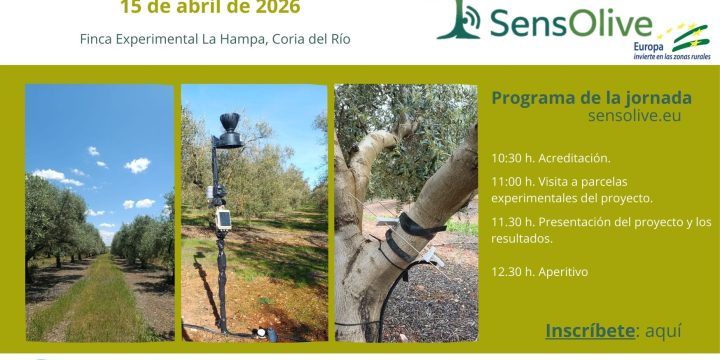
On April 15, 2026, the "La Hampa" Experimental Farm in Coria del Río (Sevilla) will host the SensOlive Results Day. This key event will showcase how cutting-edge technology is transforming water management in olive cultivation. Towards a More Sustainable and Competitive Olive Grove In the face of climate change and water scarcity, optimizing irrigation is more vital than ever. During the session, attendees will discover firsthand how the project integrates: Dendrometers and Advanced Sensors: For precise monitoring of tree status. Digital Twins and Artificial Intelligence: Creating predictive models for intelligent decision-making. Deficit Irrigation Strategies: Moving toward a more sustainable and competitive agriculture. Event Program The day is designed to be dynamic, combining field demonstrations with technical presentations: 10:30 AM: Registration. 11:00 AM: Visit to experimental plots to see the project's technology in…
Read More
Diverso Lab Researchers Receive Best Software Paper Award 2025

Diverso Lab Researchers Receive Best Software Paper Award 2025

Uncategorized
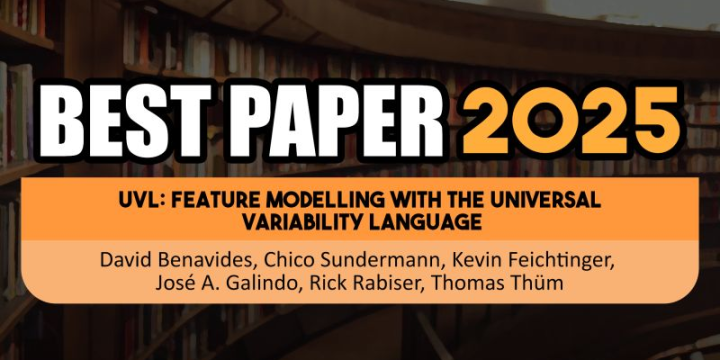
Researchers from Diverso Lab at the University of Seville have received the Best Paper Award 2025 (Regular Track) from the Journal of Systems and Software, one of the leading journals in software engineering. The award recognizes the most impactful scientific contributions published during the year. The awarded article, “UVL: Feature Modelling with the Universal Variability Language”, is led by David Benavides (University of Seville) and co-authored with Chico Sundermann, Kevin Feichtinger, José A. Galindo (University of Seville), Rick Rabiser, and Thomas Thüm.The paper introduces Universal Variability Language (UVL), a human-readable and extensible language designed to provide a common foundation for feature modeling, a key technique in software product line engineering. UVL enables the systematic management of different software configurations, which is essential in industrial contexts where products exist in multiple…
Read More
8M: Más mujeres en tecnología para un futuro más justo e innovador

8M: Más mujeres en tecnología para un futuro más justo e innovador

Uncategorized
"4th Wave Of Feminism" de Ellis van der Does Cada 8 de marzo, el Día Internacional de la Mujer nos invita a reflexionar sobre los avances conseguidos en materia de igualdad y, al mismo tiempo, sobre los desafíos que aún persisten. En el ámbito de la ciencia y la tecnología, estos retos siguen siendo especialmente visibles. A pesar de que vivimos en una sociedad profundamente digitalizada, la presencia de mujeres en el sector tecnológico continúa siendo claramente minoritaria, especialmente en los puestos de responsabilidad y liderazgo. Los datos muestran con claridad esta brecha. En España, solo alrededor del 18-19,5 % de los especialistas digitales son mujeres, según indicadores de la economía digital y estudios recientes de organismos públicos como Red.es. Además, aunque muchas empresas cuentan con profesionales TIC en sus…
Read More
Software Variability as a new Computational Thinking dimension

Software Variability as a new Computational Thinking dimension

Announcement, Product lines, Uncategorized
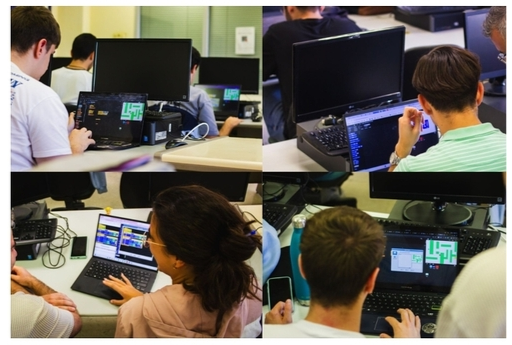
A new Open Educational Resource (OER) has been released to help bring software variability — an emerging and research-supported dimension of computational thinking — into the classroom.The resource encourages students to move beyond creating isolated programs and instead learn how to reason about families of related solutions through configurable systems.Designed mainly for teachers and students in secondary education and vocational training, the OER connects computational thinking with everyday situations such as customizing a smartphone or choosing options in a video game.Through interactive activities, modeling exercises, and programming tasks, learners explore how shared structures can generate multiple variations.The resource is organized into five modules, including an introduction to variability concepts, modeling with diagrams and the Universal Variability Language (UVL), metaprogramming using Snap!, a configurable maze game project, and a gamified assessment…
Read More
How do LLMs really work? We have an answer

How do LLMs really work? We have an answer

Events, Seminar, Uncategorized
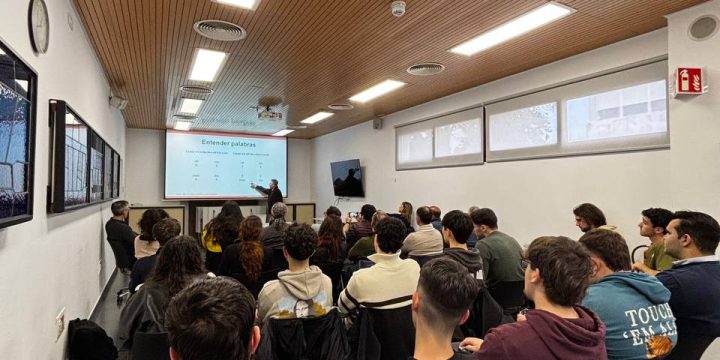
The seminar “¿Cómo funcionan los LLMs? Una explicación simple y accesible” delivered by Jesús Moreno León at the School of Computer Engineering of the University of Seville, concluded with outstanding attendance and a very positive reception from participants.Organized as part of the seminar series “Computer Science at the Crossroads,” the session brought together students, educators, and researchers interested in gaining a clear understanding of how large language models operate and the growing impact of artificial intelligence. The talk covered key concepts such as transformer architectures, machine learning foundations, and the role of AI assistants in educational and professional contexts. Thanks to its accessible and outreach-oriented approach, the seminar enabled attendees with diverse backgrounds to follow the explanations easily and actively engage in the discussion session that followed, fostering meaningful reflection…
Read More
Celebrating International Day of Women and Girls in Science

Celebrating International Day of Women and Girls in Science

Events, Uncategorized
Today we celebrate the incredible contributions of women and girls in science, technology, and innovation.We are proud to have in our lab team women dedicated to the field of computer science. Every day, they contribute to research, development, and problem-solving in a space that continues to grow and evolve thanks to diversity, curiosity, and collaboration.Being women in tech means not only building solutions and advancing knowledge, but also inspiring the next generation of girls to see themselves in science, data, code, and innovation. Megha Bhushan Noelia López Durán Asmaa Hasan Sbaih Ana Eva Chacón-Luna Esther Rocío Valladolid Ortíz Representation matters. Opportunities matter. Support matters.On this International Day of Women and Girls in Science, we reaffirm our commitment to fostering inclusive environments where talent thrives — regardless of gender.Here’s to curiosity,…
Read More
How do LLMs really work?

How do LLMs really work?

Events, Seminar, Uncategorized
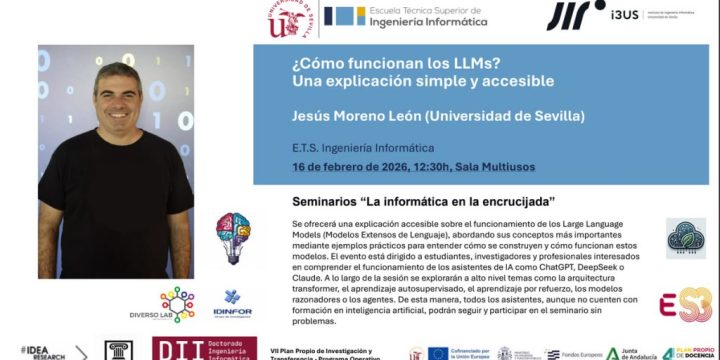
On February 16th, 2026, at 12:30 PM, the seminar entitled “¿Cómo funcionan los LLMs Una explicación simple y accesible” will take place in the Multi-Purpose Room at the School of Computer Engineering (University of Seville). The session will be delivered by our colleague Professor Jesús Moreno León.The seminar will provide a clear and accessible explanation of how Large Language Models (LLMs) work, covering their fundamental concepts through practical examples that help the audience understand how these models are built and how they are applied in current technological solutions.The event is aimed at students, researchers, and professionals interested in understanding how AI assistants such as ChatGPT, DeepSeek, or Claude operate. High-level topics such as transformer architecture, self-supervised learning, and reinforcement learning will be discussed from a divulgative perspective, avoiding unnecessary technicalities or…
Read More
Final Event of the AQUAIA Project – Results and Insights

Final Event of the AQUAIA Project – Results and Insights

Uncategorized
Last Wednesday, May 28th, the AQUAIA Operational Group held the final event of its project and what a wonderful day it was! We had the opportunity to visit the experimental plots, watch the results of the project and dive into the key results of a project that’s been pushing the boundaries of sustainable agriculture. AQUAIA has developed an innovative tool for optimizing irrigation in organic horticultural systems, powered by highly customizable artificial intelligence models to enhance water-use efficiency. We’re pleased to share the final project video, which includes a clear overview of our work and outcomes, featuring our colleague José Ángel Galindo Duarte: https://www.youtube.com/watch?v=8ELDO1U2m5A Thanks to everyone who joined us for the event and contributed to making this project a success!This marks the end of the project, but just the…
Read More

State of art in computational pathology

Uncategorized
On Tuesday, November 12th, Professor Jorge García Gutiérrez gave a presentation on the state of the art in computational pathology, focusing on the open challenges within his project "Optimized Knowledge-Federated Assembly of Autocoded Nodes" (ENFOCA) in Digital Pathology. ENFOCA seeks to advance digital pathology through the integration of optimized and federated knowledge networks. The project aims to enhance pathologists' work by leveraging artificial intelligence to support and optimize their analyses. Computational pathology holds great potential for improving pathologists' performance by increasing accuracy, efficiency, and diagnostic consistency. Additionally, the presentation included an overview of previous work in fields such as environmental remote sensing, autonomous vehicle technology, and renewable energy production forecasting.
Read More