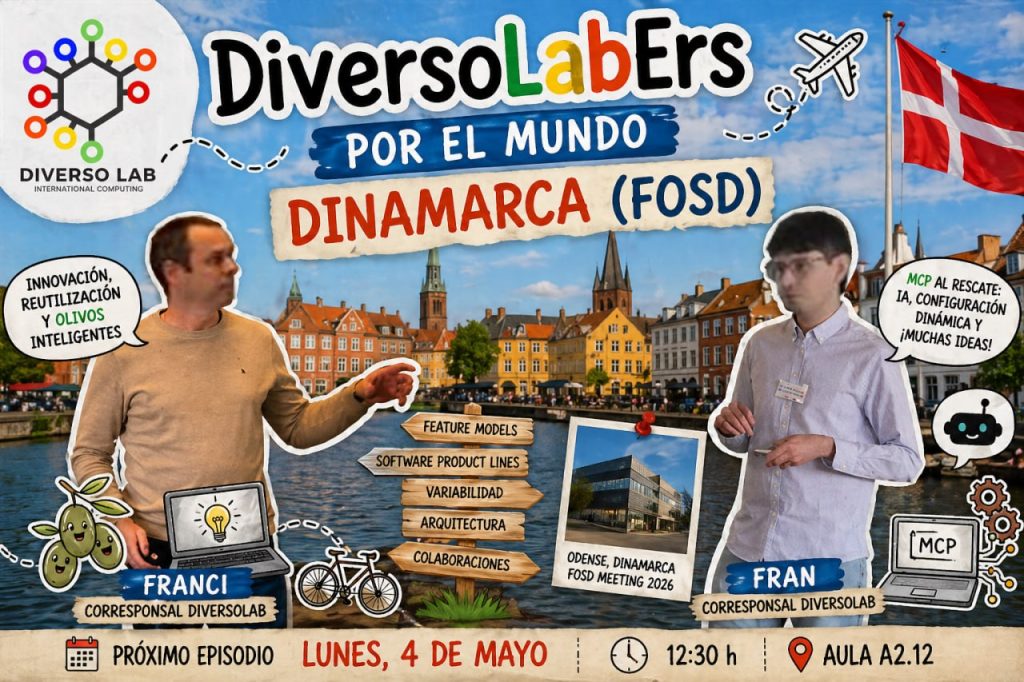
Following the recent participation of our researchers Francisco José Domínguez-Mayo and Francisco Sesbastián Benítez at the FOSD (Feature-Oriented Software Development) Meeting—a prominent international gathering dedicated to advancing research in software variability and software product lines, see more here —we held an internal seminar at our facilities. Upon their return, Francisco J. and Francisco S. shared their experiences and the presentations they delivered at the conference with the entire DIVERSO LAB team from the University of Seville. This knowledge-sharing session focused on the application of software engineering and Artificial Intelligence to the agricultural sector.
Towards the Systematic Engineering of Intelligent Systems
The first presentation was given by Francisco J. Domínguez-Mayo, who introduced the line of work titled “Toward an Innovation-Oriented SPL Methodology for On-Premise Intelligent Systems”. During his exposition, he emphasized the need to drive innovation through systematic reuse.
To achieve this, Domínguez-Mayo proposed integrating research and innovation cycles into Software Product Line (SPL) methodologies. He highlighted smart agriculture as the ideal scenario and real-world testbed for these systems. Because agriculture is a high-variability domain, it is perfectly suited for applying the SPL techniques we have been developing in ongoing projects such as AquaIA and SensOlive. The primary goal of this research is to transition from purely “ad-hoc” innovation to the true systematic engineering of intelligent systems.

Dynamic Interfaces and AI Configuration
Next, Francisco S. Benítez took the floor to present “Integration of Feature Models into the Model Context Protocol (MCP) for Dynamic Configuration of Data Analysis Interfaces”. His talk delved into the Model Context Protocol (MCP), a standard introduced by Anthropic in late 2024 to efficiently connect AI models with various external tools.
Benítez illustrated the practical utility of this protocol by applying the architecture to the SensOlive project, which focuses on deficit irrigation in olive groves using dendrometers and intelligent digital twins. He demonstrated how implementing an MCP server within the SensOlive platform enables users to interact with an Artificial Intelligence-assisted chat interface. Through practical use cases, he showed how this tool allows users to intuitively automate irrigation processes, configure new digital twins, and train or validate prediction models. Furthermore, he noted that the variability of these configurations is managed and validated using the flamapy tool.
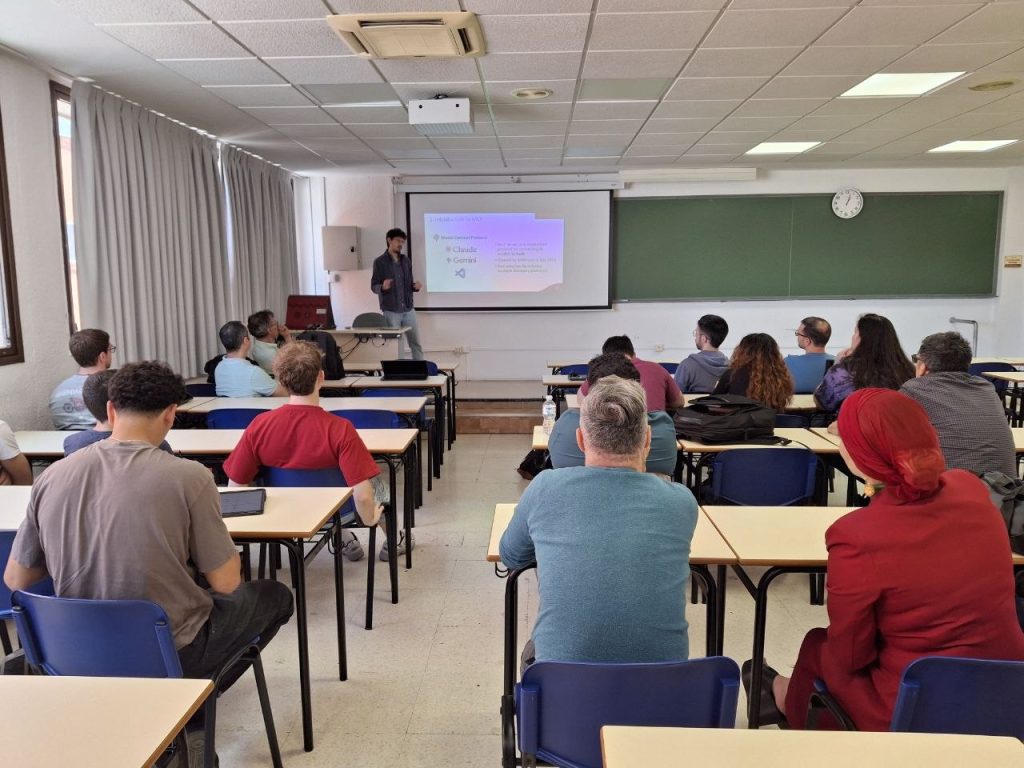
This internal seminar proved to be a highly enriching space for discussion, allowing us to consolidate our knowledge and align the next steps for our laboratory’s research.
We were also especially delighted to have Asma and Raouf join us for this seminar.
Congratulations to the speakers and the entire team involved!
Previous news on the subject:
AI and Smart Agriculture: Our Team at FOSD 2026 (Denmark)