
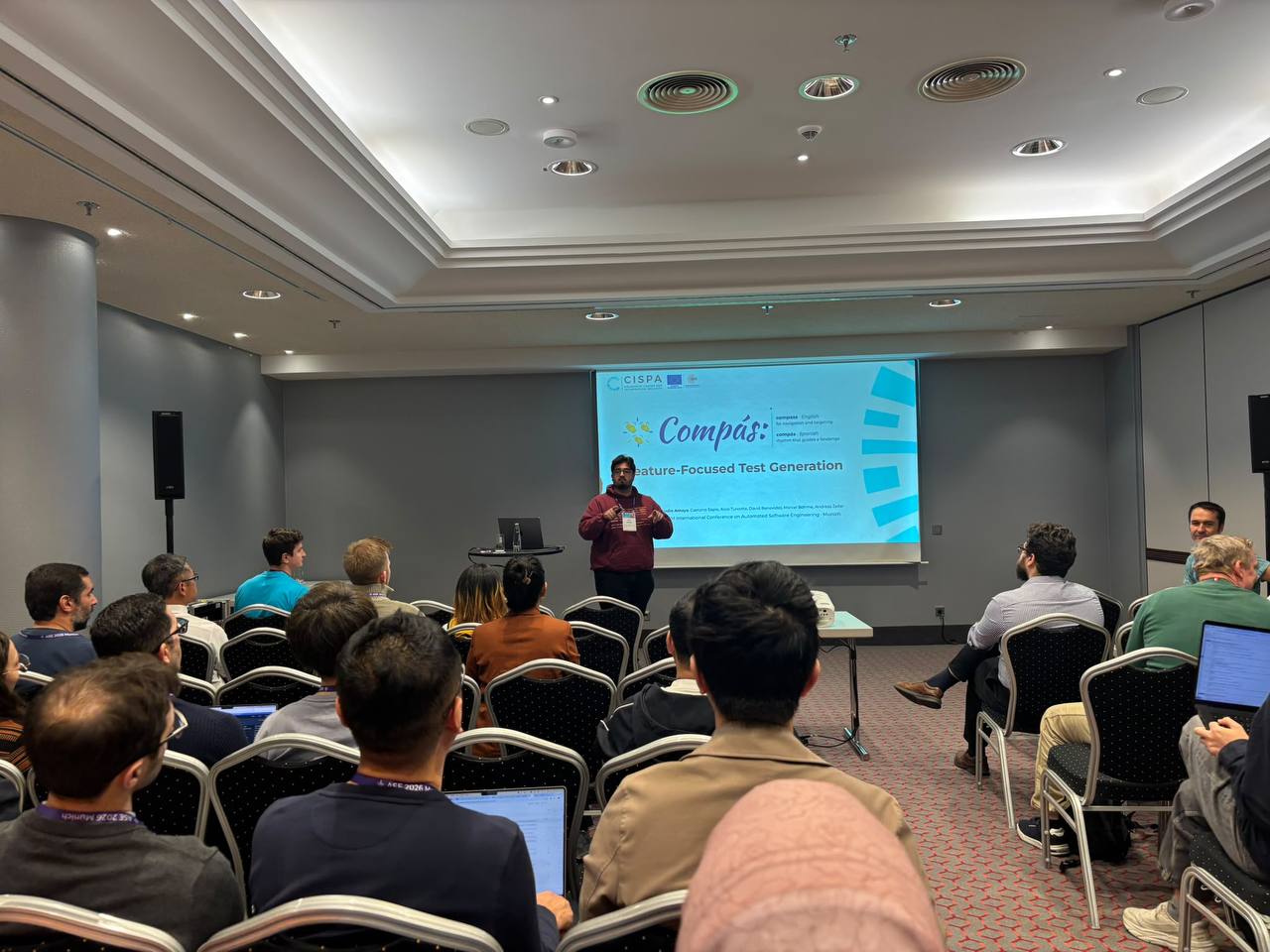
José Antonio Zamudio Amaya presented the paper “Feature-Focused Test Generation” at the 41st IEEE/ACM International Conference on Automated Software Engineering (ASE 2026), held in Munich, Germany, from 12 to 16 October 2026. The work was presented in the main track on Wednesday 14 October in Forum 7. A poster session ran throughout the same day.
The paper is co-authored by José Antonio Zamudio Amaya, Gaetano Sapia, Alexi Turcotte, Marcel Böhme and Andreas Zeller (CISPA Helmholtz Center for Information Security and MPI-SP), and David Benavides (Instituto de Ingeniería Informática, Universidad de Sevilla). It is the first joint publication between Diverso Lab and CISPA, and brings together two research communities: language-based testing and software product line engineering.
What the work proposes
Specification-based test generators produce valid inputs that cover the whole input space of a system. That breadth becomes a limitation when a tester wants to concentrate on one particular feature, for example a part of a parser that has recently changed. Feature-Focused Test Generation (FFTG) treats this problem as a configuration problem. The approach automatically extracts a feature model from an input specification. The tester then selects the features of interest, and FFTG specializes the specification so that only those features vary in the generated inputs.
The approach is implemented in Compás, an open-source prototype built on the FANDANGO test generator. Compás exports its feature models in UVL, the Universal Variability Language, so they work directly with existing feature-model analysis tools.
Key results
The evaluation covered ten real input formats across seven parser libraries, including image, audio, archive, document and configuration formats. Its main findings were:
- Generated inputs remain fully valid, and diversity and coverage are preserved.
- Targeted slices always reach the code region of the chosen feature. On average, all of their inputs exercise that region, compared with 26% for unfocused generation.
- Features can be traced to the specific code they exercise. This supports regression testing and debugging.
- Test suites can be reduced to one or two labelled slices per format. These slices reach each region in up to 18.5 times fewer inputs than the baseline.
To the best of the authors’ knowledge, this is the first work to apply product line engineering techniques to specification-based testing.
The paper is available at https://doi.org/10.1145/3832783.3837479. The source code of Compás and the replication package are available at https://doi.org/10.6084/m9.figshare.31855447.v3
This research was funded by the European Union (ERC 101093186 and ERC 101179366) and partially supported by the Spanish State Research Agency through the PREMISE project (PID2025-171313OB-I00).