

On 29 September 2026, the work “UVL-Supported Configuration for YOLOv11 Face Detection” was presented at MODEVAR 2026, the International Workshop on Languages for Modelling Variability, held as part of VARIABILITY 2026 in Limassol, Cyprus. The research was led by Haya Alhadramy (Al al-Bayt University, Jordan), in collaboration with Francisco S. Benítez, David Romero-Organvidez and José A. Galindo from the University of Seville.
The work addresses a common problem in deep learning practice: choosing a model configuration. Training a face detector involves dozens of interdependent decisions, from backbone scale and attention blocks to input resolution, augmentation, precision and post-processing. These choices are usually made by hand, often copied from previous projects, with nothing to check that the resulting combination is coherent.
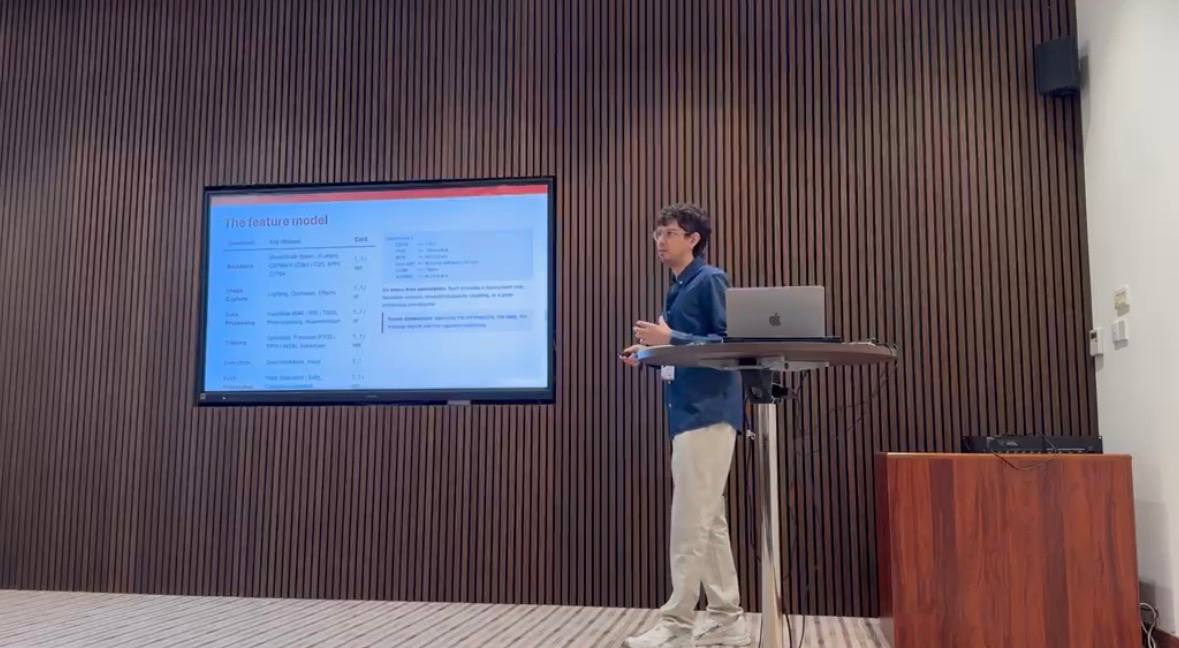
The authors apply software product line engineering to this problem. They model the YOLOv11 configuration space as a feature model written in the Universal Variability Language (UVL), with 76 features and 6 cross-tree constraints encoding deployment rules. Using flamapy, they verify that the model is consistent and has no dead features, and compute through exact model counting that it contains 2,926,264,320 valid configurations. A translation layer then turns any validated selection into executable parameters for the Ultralytics training API, and a Streamlit configurator ensures that only valid configurations can be built.
An evaluation on a benchmark derived from WIDER FACE shows that the approach exposes clear and interpretable trade-offs. Data augmentation nearly doubles detection accuracy, the nano backbone matches the small one at roughly half the inference latency, and larger models overfit the compact training set. Each of these effects maps to a named feature that practitioners can select, making experiments reproducible and easy to compare.
The feature model, translation layer, configurator and experiment scripts are publicly available at github.com/diverso-lab/yolo-uvl-face-detection.
This work was funded by FEDER, MICIU, Junta de Andalucía and AEI through the projects Data-pl (PID2022-138486OB-I00), PREMISE (PID2025-171313OB-I00), PLANT (DGP_PIDI_2024_01144) and SENSOLIVE (PLSQ_00162).