

Precision irrigation is no longer an option, it’s an urgent necessity.
Against a backdrop of structural drought and climate change, the agricultural sector needs disruptive solutions capable of breaking down the cost barriers that have long kept advanced monitoring technology out of reach for most farms.
The SensOlive team is responding to that challenge with a framework that virtualises dendrometer sensors, overcoming the cost and maintenance limitations that prevent the large-scale deployment of physical hardware across olive estates. The team (Daniel Molina Torres, Miguel Ángel Olivero González, Francisco José Domínguez Mayo, Jorge García Gutiérrez and Jesús Moreno León) shared this work in progress at JIETSII 2026, the research conference of the ETSII, held on 8–9 June.
Walking the fine line of deficit irrigation
The agronomic challenge is a delicate one. Regulated Deficit Irrigation (RDI) can dramatically improve water efficiency, but the margin for error is razor-thin: the line between beneficial stress and permanent physiological damage demands precision monitoring. Physical dendrometers can deliver that precision, recording data every 15 minutes, but their cost, their fragility in field conditions and their limited reach make it impossible to instrument an entire estate with hardware alone.
A digital twin instead of more hardware
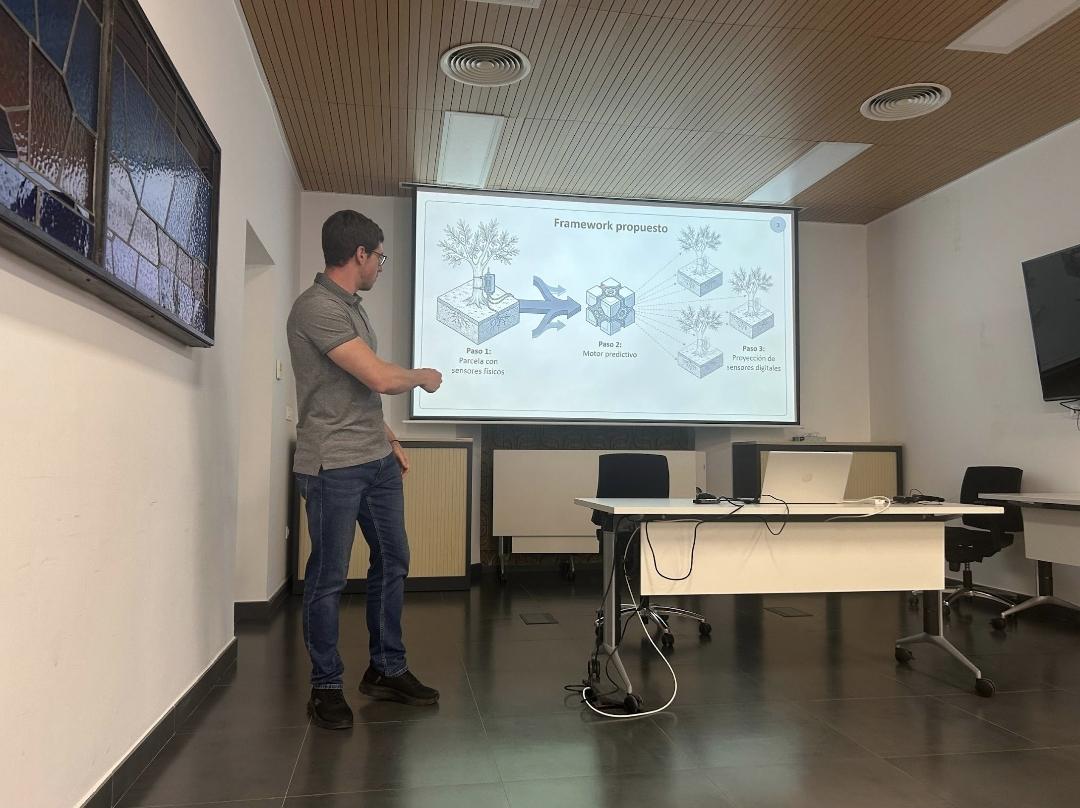
SensOlive’s answer is to combine a handful of physical sensors with digital twins. Crucially, the model does not attempt to predict the future, it reconstructs the current dendrometric state of the tree in areas where no physical sensor exists, multiplying spatial coverage while keeping hardware to a minimum.
To do this, the framework relies on a multi-output LSTM neural network that fuses three kinds of data, the trunk’s own physiological history (maximum daily shrinkage and trunk growth rate), climate and phenology variables, and satellite remote-sensing indices (NDVI, SAVI and EVI) from Sentinel-2. A convolutional layer captures heat waves and abrupt thermal transitions, while the LSTM core remembers the tree’s prior water-stress history.
Prioritising the tree’s wellbeing
One of the framework’s most distinctive features is its asymmetric loss function, deliberately designed to protect the plant. A false alarm, predicting stress in a healthy tree, carries a low penalty, since it merely leads to slightly more irrigation. “Hidden stress”, by contrast, failing to detect a tree that is genuinely suffering, is penalised severely, because that delay can cause irreversible damage.